Decode Media Latent
Runs the pipeline's VAE decoder on a latent, producing an image or video — typically the final node in a flow.
Category: ModularDiffusion/Encode\Decode
TL;DR
- Output is dynamic:
output_imagefor image pipelines,output_video(+fps) for video pipelines (LTX, LTX2, WAN). It swaps automatically when you connect apipeline. - Almost always the last node in the flow. Connect to a Save Image / Save Video node downstream.
Typical workflow position
Generate Media Latents → [Decode Media Latent] → Save Image / Save Video
Node preview
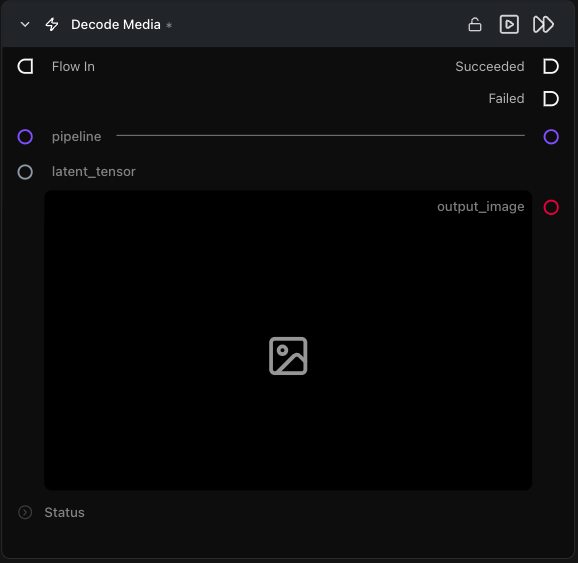
Inputs
| Name | Type | Required | Notes |
|---|---|---|---|
pipeline |
Pipeline Config |
Yes | Must match the pipeline that produced the latent. |
latent_tensor |
LatentArtifact |
Yes | Latent to decode. |
Outputs
| Name | Type | Notes |
|---|---|---|
output_image |
ImageArtifact |
For image pipelines. |
output_video |
VideoUrlArtifact |
For video pipelines. |
Parameters
| Name | Type | Default | Notes |
|---|---|---|---|
fps |
int (1–120) | 25 |
Output frame rate. Only shown for video pipelines. |
Tips & pitfalls
- Use the same pipeline that produced the latent. Each pipeline carries the VAE it was trained with — decoding a latent with a mismatched VAE produces corrupt output.
- Large latents need more VRAM to decode. High-resolution or multi-frame latents require more memory during decode. Enable
vae_slicingon the Pipeline Builder to decode in batches and keep peak VRAM usage lower.
See also
- Encode Media Latent — inverse operation.
- Generate Media Latents — typical upstream node.